
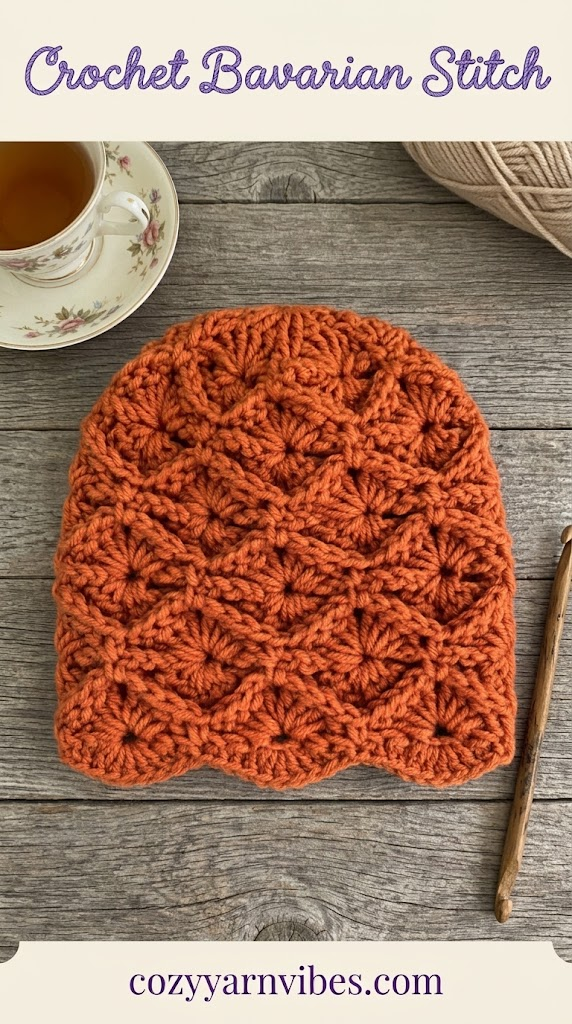
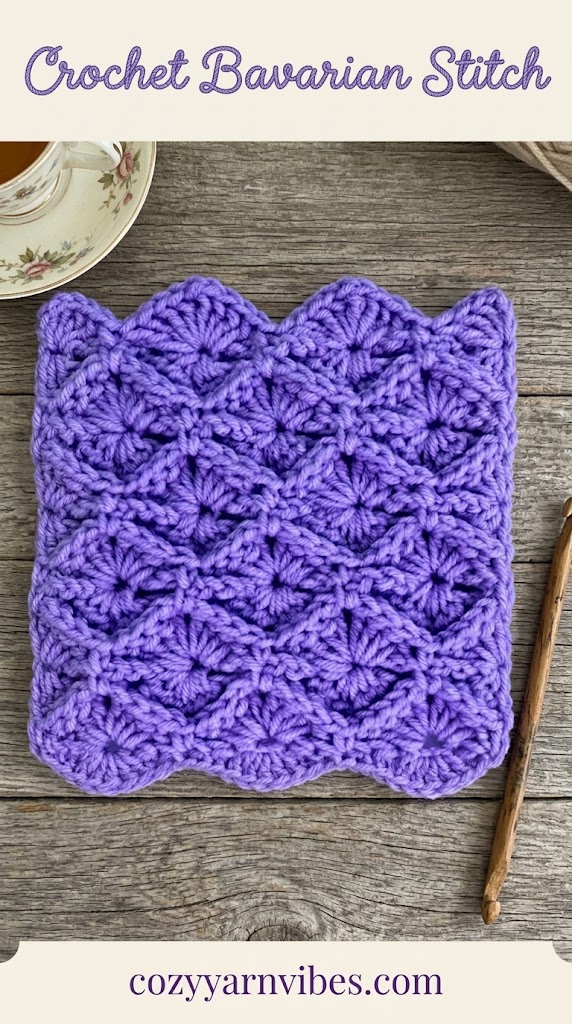
The Bavarian stitch is a beautiful crochet technique known for its raised texture, repeating shells, and dimensional appearance. It combines clusters, fans, chain spaces, and front post stitches to create a richly textured fabric that looks intricate while following a repeating pattern.
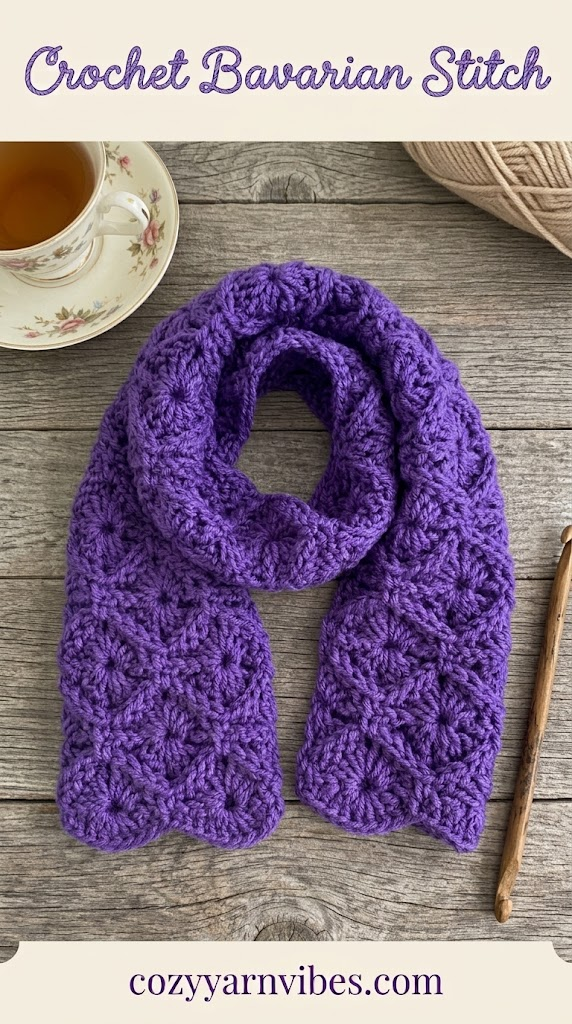
This stitch is especially beautiful for blankets, cushions, scarves, bags, and other projects where you want plenty of texture. Although the Bavarian stitch uses a few special stitches, the pattern becomes easier to follow once you understand how the front post clusters are made.
In this guide, you’ll learn what the Bavarian stitch is, the abbreviations and special stitches used, how to crochet it step by step, useful tips for beginners, common mistakes to avoid, project ideas, variations, and frequently asked questions.
Bavarian Stitch Definition
The Bavarian stitch is a textured crochet stitch made by combining fans, front post double crochet clusters, half clusters, single crochet stitches, and chain spaces. These elements work together to create a raised, layered texture that gives the finished fabric a distinctive three-dimensional look.
Unlike simple crochet stitches, the Bavarian stitch has several repeating rows. The pattern is built around a six-row sequence, with Rows 3 through 6 repeated to continue the design.
The stitch is worked in multiples of six plus three, with one additional beginning chain. This makes it easy to adjust the width of your project once you understand the stitch repeat.
Abbreviations
This free pattern is written using US crochet terms.
Bet between
Ch chain
Ch-sp chain space
Dc double crochet
Rep repeat
Sc single crochet
Sk skip
st (s) stitch (es)
Special Stitches
Before starting the Bavarian stitch, it helps to understand the two special cluster stitches used throughout the pattern.
Fan
A fan is made by working:
(4 dc, ch 1, 4 dc) in the indicated stitch.
This creates a wide, symmetrical group of double crochet stitches that forms one of the main textured elements of the Bavarian stitch.
Front Post Double Crochet Cluster (fpdc-cl)
The front post double crochet cluster is worked around the posts of double crochet stitches.
- Yarn over, insert your hook around the post of the next dc, yarn over, pull up a loop, yarn over, and pull through 2 loops on your hook. Repeat this 4 times. You should now have 5 loops on your hook.
- Skip the next sc.
- Yarn over, insert your hook around the post of the next dc, yarn over, pull up a loop, yarn over, and pull through 2 loops on your hook. Repeat this 4 times. You should now have 9 loops on your hook.
- Yarn over and pull through all the loops on your hook.
- Chain 1 to close the cluster.
Front Post Double Crochet Half Cluster (fpdc-half-cl)
The front post double crochet half cluster is a shorter version of the cluster.
- Yarn over, insert your hook around the post of the next dc, yarn over, pull up a loop, yarn over, and pull through 2 loops on your hook. Repeat this 4 times. You should have 5 loops on your hook.
- Yarn over and pull through all the loops on your hook.
- Chain 1 to close the cluster.
How to Crochet the Bavarian Stitch
The Bavarian stitch begins with a simple single crochet foundation row. The following rows introduce fans and front post clusters to build the raised texture.
The foundation chain should be:
Any multiple of 6 + 3, plus 1 beginning chain.
For example, you can start with a chain that follows this formula and adjust the length according to your project.
Step 1: Make the Foundation Chain
Start with a foundation chain using any multiple of 6 + 3, plus 1 beginning chain.
Make sure your chain is loose enough to work single crochet stitches into it comfortably. Avoid pulling the chain too tightly, as this can make the first row difficult to crochet and may cause the finished fabric to become uneven.
Step 2: Crochet Row 1
Row 1 is worked entirely in single crochet stitches.
Chain 1, then work 1 sc in the second chain from the hook.
Continue working 1 sc in each chain across the row.
Turn your work when you reach the end.
This creates a solid foundation for the textured Bavarian stitch pattern.
Step 3: Crochet Row 2
Row 2 introduces the first fans.
Chain 3. This counts as the first double crochet.
Work 4 dc in the next sc.
Skip the next 2 sc, then work 1 sc in the next sc.
Continue the repeating sequence:
- Skip the next 2 sc.
- Work a fan in the next sc.
- Skip the next 2 sc.
- Work 1 sc in the next sc.
Repeat this sequence across the row until you reach the final stitches.
Skip the next 2 sc, work 4 dc in the next sc, then work 1 dc in the last sc.
Turn your work.
At the end of this row, the fan groups create the first layer of the Bavarian stitch texture.
Step 4: Crochet Row 3
Row 3 begins creating the raised cluster sections.
Chain 1, then work 1 sc in the first stitch.
Then, Chain 3, then work a front post double crochet cluster (fpdc-cl).
Chain 3.
Repeat the following sequence across the row:
1 sc in the next ch-1 space, ch 3, fpdc-cl, ch 3.
Continue repeating this sequence until you reach the last stitch.
Work 1 sc in the last stitch, then turn.
The front post clusters begin to create the distinctive raised texture of the Bavarian stitch.
Step 5: Crochet Row 4
Row 4 builds another layer of fans over the clusters.
Chain 1, then work 1 sc in the first stitch.
Repeat the following sequence across the row:
- Skip the next ch-3 space.
- Work a fan in the top of the next fpdc-cl.
- Skip the next ch-3 space.
- Work 1 sc in the next stitch.
Continue repeating this sequence to the end of the row.
Turn your work.
The fans worked over the clusters create the rounded, dimensional sections that make this stitch so recognizable.
Step 6: Crochet Row 5
Row 5 introduces the front post double crochet half clusters.
Chain 3. This counts as the first dc.
Work an fpdc-half-cl.
Then repeat the following sequence:
ch 3, 1 sc in the next ch-1 space, ch 3, fpdc-cl.
Continue repeating until you reach the last ch-1 space.
Work ch 3, 1 sc in the next ch-1 space, ch 3, fpdc-half-cl, then finish with 1 dc in the last stitch.
Turn your work.
Step 7: Crochet Row 6
Row 6 adds another layer of fans and completes the main six-row sequence.
Chain 3. This counts as the first dc.
Work 4 dc in the top of the next fpdc-half-cl.
Then repeat:
- Skip the next ch-3 space.
- Work a fan in the top of the next fpdc-cl.
- Skip the next ch-3 space.
- Work 1 sc in the next sc.
Continue repeating this sequence across the row.
When you reach the final ch-3 space, skip it, then work 4 dc in the top of the next fpdc-half-cl.
Finish with 1 dc in the last stitch and turn.
Your first complete six-row Bavarian stitch sequence is now finished.
Step 8: Repeat the Pattern
Once Rows 1 through 6 are complete, continue the pattern by repeating Rows 3 through 6.
Repeat these four rows until your crochet project reaches the desired length.
Because Rows 3 through 6 build upon the existing fans and clusters, the characteristic Bavarian texture becomes more visible as you continue.
Pro Tip: Pay close attention to the tops of your front post clusters and the ch-1 spaces inside the fans. These are important placement points for the following rows.
Tips for Perfect Bavarian Stitch
- Keep your tension consistent throughout every row.
- Count your stitches and repeating sections carefully.
- Learn the fpdc-cl and fpdc-half-cl before starting a large project.
- Make sure your front post stitches are worked around the correct dc posts.
- Keep your chain spaces consistent in size.
- Avoid making your cluster stitches too tight.
- Practice the six-row repeat on a small swatch first.
- Use stitch markers to help identify important fan and cluster positions.
- Block the finished piece to help open the texture and even out the fabric.
Common Mistakes to Avoid
The Bavarian stitch can look complicated at first because several special stitches are used together. Most mistakes, however, come from losing track of the repeating sequence.
Here are some common problems to watch for:
- Skipping the wrong stitches: Carefully follow every sk instruction, especially around the ch-3 spaces.
- Working clusters around the wrong posts: Make sure your hook is inserted around the indicated dc post.
- Missing the ch-1 space: The ch-1 spaces inside the fans are important placement points in later rows.
- Incorrect cluster counts: Follow the steps for each fpdc-cl carefully.
- Uneven tension: Tight clusters can make the fabric stiff and difficult to work into.
- Losing the row repeat: After completing Row 6, remember that Rows 3 through 6 are repeated.
- Incorrect foundation chain: Make sure your starting chain follows the required stitch multiple.
If the texture begins to look uneven, stop and compare your work with the previous row before continuing.
Projects You Can Make with the Bavarian Stitch
The dense, raised texture of the Bavarian stitch makes it suitable for projects where you want both visual interest and substantial fabric.
Blankets
Bavarian stitch is especially popular for blankets because the textured design creates a cozy and decorative fabric. Use one color for a classic look or several colors to emphasize the individual fans and clusters.
Cushion Covers
The dimensional texture works beautifully on cushion covers. A Bavarian stitch panel can turn a simple pillow into an eye-catching decorative piece.
Scarves and Shawls
Use a lighter yarn to create scarves and shawls with intricate texture. The repeating pattern adds visual interest without requiring complicated colorwork.
Bags
Bavarian stitch can be used for handbags, totes, and pouches. The dense structure is useful for bags that need more body and texture.
Home Décor
Try the stitch for table runners, placemats, throws, wall hangings, and other decorative pieces. The raised design adds a handcrafted look to home accessories.
Accessories
Smaller projects such as cowls, hats, headbands, and book covers can also showcase the Bavarian stitch without requiring a large amount of yarn.
Bavarian Stitch Variations
Once you are comfortable with the basic Bavarian stitch, you can experiment with different yarns, colors, and project constructions.
- Two-Color Bavarian Stitch: Alternate colors between rows to make the fans and clusters stand out.
- Multicolor Bavarian Stitch: Use several shades for a vibrant, geometric appearance.
- Single-Color Bavarian Stitch: Work the entire piece in one color for a subtle, highly textured design.
- Lightweight Bavarian Stitch: Use lighter yarn and a suitable hook for scarves, shawls, and garments.
- Chunky Bavarian Stitch: Use thicker yarn for warm blankets and substantial home décor projects.
Changing the color placement can dramatically change the appearance of the finished stitch even when the basic pattern remains the same.
More Crochet Stitch Tutorials
Continue building your crochet skills with beginner-friendly stitch guides:
- Single Crochet Stitch (sc)
- Half Double Crochet Stitch (hdc)
- Double Crochet Stitch (dc)
- Treble Crochet Stitch (tr)
- Shell Stitch
Learning basic stitches first will make special techniques such as the Bavarian stitch much easier to understand.
Conclusion
The Bavarian stitch is a beautiful textured crochet technique that combines fans, chain spaces, and front post clusters to create a dimensional fabric. While the stitch uses more steps than a simple crochet pattern, the repeating structure makes it easier to master with practice.
Start with a small swatch and focus on learning the fpdc-cl and fpdc-half-cl first. Once you are comfortable with the six-row sequence, you can repeat Rows 3 through 6 to create blankets, bags, scarves, cushion covers, and many other projects.
Frequently Asked Questions (FAQs)
1. Is the Bavarian stitch suitable for beginners?
The Bavarian stitch is best suited to adventurous beginners who already know basic crochet stitches such as chain, single crochet, and double crochet. The special front post clusters require some practice, but the repeating pattern becomes easier to follow once you understand them.
2. What stitches are used in the Bavarian stitch?
The pattern uses chain stitches, single crochet, double crochet, fans, front post double crochet clusters, and front post double crochet half clusters.
3. How many chains do I need to start the Bavarian stitch?
The foundation chain is worked as any multiple of 6 + 3, plus 1 beginning chain. This allows you to adjust the width of the project while maintaining the stitch repeat.
4. What is a Bavarian stitch fan?
A Bavarian stitch fan is made by working 4 dc, ch 1, 4 dc into the indicated stitch. This creates a wide, textured group that forms one of the main elements of the pattern.
5. What is an fpdc-cl?
An fpdc-cl, or front post double crochet cluster, is a cluster made around the posts of designated double crochet stitches. The loops are worked in stages and then pulled together before a chain is made to close the cluster.
6. Can I make the Bavarian stitch in different colors?
Yes. The Bavarian stitch looks beautiful in both single-color and multicolor designs. Changing colors between rows can make the fans, clusters, and repeating sections more noticeable.
7. Can the Bavarian stitch be used for blankets?
Absolutely. Its dense, textured construction makes it particularly suitable for blankets, throws, and other cozy projects. Choose a yarn weight and hook size appropriate for the type of blanket you want to make.
8. Why does my Bavarian stitch look too tight?
Tight tension, especially when making front post clusters, can cause the fabric to become stiff. Try relaxing your tension and avoid pulling the loops too tightly while forming the clusters.