
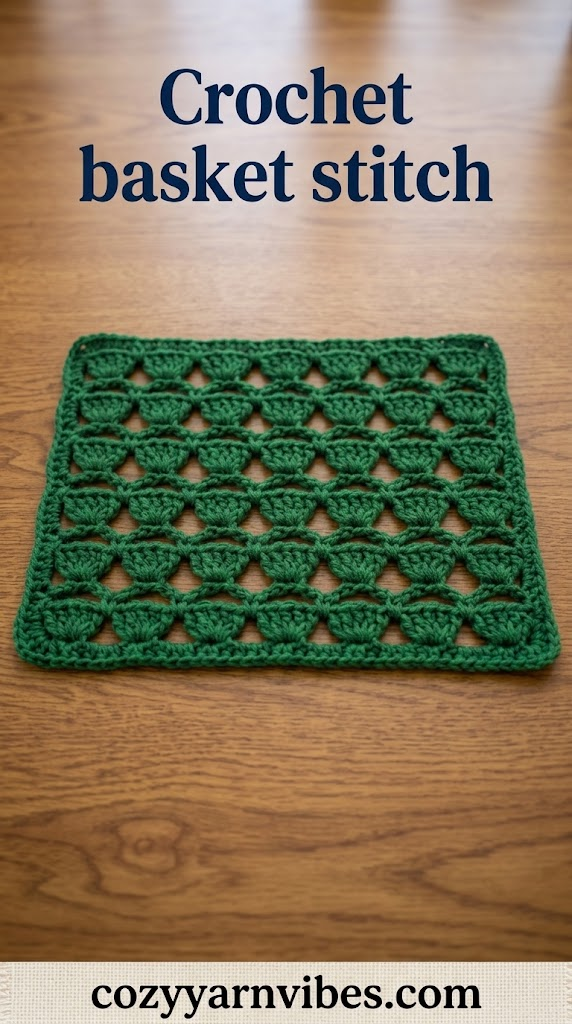
The basket stitch is a beautiful crochet stitch that creates a repeating pattern of raised shell-like groups and open spaces. Its structured texture resembles the woven appearance of a traditional basket, making it a great choice for projects where you want both texture and visual interest.
The basket stitch is worked using groups of five double crochet stitches separated by skipped chains and chain-5 spaces. The stitch pattern uses a simple three-row setup, after which Rows 2 and 3 are repeated to build the textured fabric.
In this guide, you’ll learn what the basket stitch is, which abbreviations are used, how to crochet the stitch step by step, helpful tips for keeping your shells aligned, common mistakes to avoid, and project ideas for using this textured stitch.
Basket Stitch Definition
The basket stitch is a textured crochet stitch made from groups of five double crochet stitches, commonly called 5-dc shells, separated by chain spaces. The alternating shell groups and open spaces create a structured pattern with a woven, basket-like appearance.
The stitch begins with a foundation chain worked to a specific multiple. The first row establishes the 5-dc shells, while the second row creates chain-5 spaces between them. The third row works new 5-dc shells into those chain spaces.
Once the first three rows are completed, Rows 2 and 3 are repeated to continue the basket stitch pattern for as many rows as needed.
Basket Stitch Abbreviations
This pattern uses US crochet terms.
Ch chain
Ch-sp chain space
Dc double crochet
Rep repeat
Sc single crochet
Sk skip
st (s) stitch (stitches)
T-ch turning chain
How to Make the Basket Stitch
Follow these steps to crochet the basket stitch pattern. Pay close attention to the placement of the 5-dc shells and chain-5 spaces because these are the main elements that create the textured design.
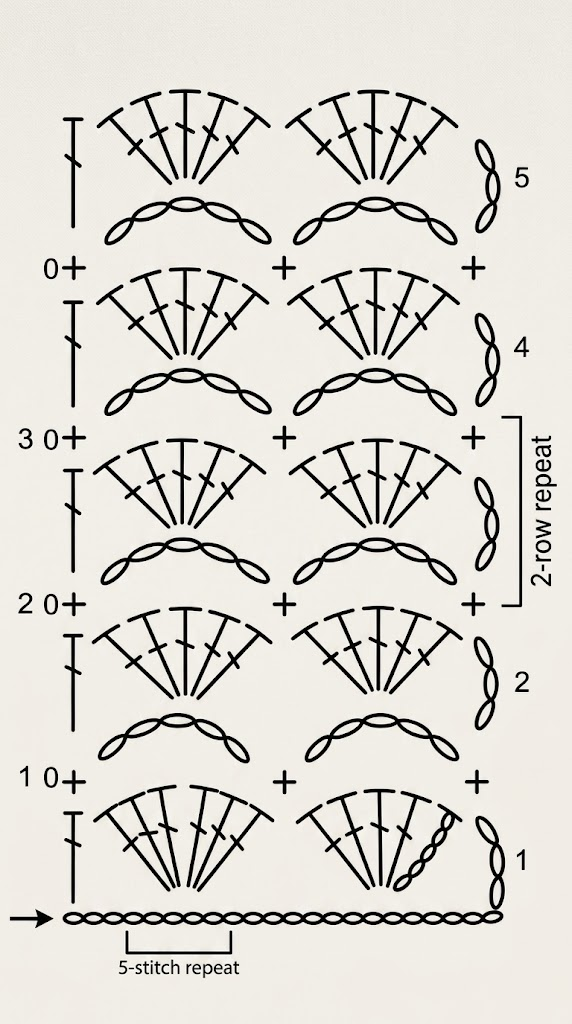
Step 1: Make the Foundation Chain
Begin with a foundation chain using the following formula:
Foundation chain: (any multiple of 5) + 2, plus 3.
The additional 3 chains account for the turning chain used to begin the first row.
For example, you can choose a multiple of 5 such as 10, 15, 20, or 25, then add 2 and 3 more chains. The resulting foundation chain should therefore contain 15, 20, 25, or 30 chains respectively.
Keep your chain tension even and avoid making the foundation chain too tight, as this can make the first row difficult to work.
Step 2: Work the First Row
Turn your foundation chain so that you can work into the chains. Skip the first 6 chains from the hook, then work 5 double crochets (dc) into the 7th chain.
These 5 double crochets form the first 5-dc shell.
Next, skip the following 4 chains and work 5 double crochets into the next chain. Repeat this sequence across the foundation chain: skip 4 chains, then work 5 double crochets into the next chain.
Continue until you reach the final 3 chains.
At the end of the row, skip the next 2 chains and work 1 double crochet into the last chain.
Turn your work.
You should now have a series of 5-dc shells separated by skipped chains, with a single double crochet at the end of the row.
Step 3: Work the First Basket Stitch Row
Row 2 creates the open chain spaces that separate the shell groups.
Begin by chaining 1. Work 1 single crochet (sc) into the first double crochet.
Next, chain 5. Locate the space between the next two 5-dc shells from Row 1 and work 1 single crochet into this space.
The single crochet is worked into the gap between the shell groups rather than into one of the individual double crochet stitches.
Step 4: Create the Chain Spaces
Continue across the row by repeating the following sequence: chain 5, then work 1 single crochet into the space between the next two 5-dc shells.
The chain-5 sections create the large open spaces that will be used in the following row for the next set of 5-dc shells.
When you reach the final 5-dc shell, chain 5 once more. Then work 1 single crochet into the space between the last 5-dc shell and the turning chain from the previous row.
Turn your work.
At the end of Row 2, you should have a series of chain-5 spaces running across the row, with single crochet stitches anchoring each space between the shell groups.
Step 5: Work the Next Row of Shells
Row 3 works new 5-dc shells into the chain-5 spaces created in Row 2.
Begin by chaining 3. This chain 3 counts as the first double crochet of the row.
Locate the next chain-5 space. Work 5 double crochets into the third chain of that chain-5 space.
This creates the next 5-dc shell.
Continue across the row by working 5 double crochets into the third chain of each following chain-5 space.
When you reach the final chain-5 space, work 5 double crochets into its third chain. Then work 1 double crochet into the last single crochet of Row 2.
Turn your work.
The new shells should sit between the shells from the previous shell row, creating the characteristic structured appearance of the basket stitch.
Step 6: Repeat the Pattern
Once Rows 1 through 3 are complete, the main basket stitch repeat has been established.
Continue repeating Rows 2 and 3 until your project reaches the desired length.
Row 2 creates the chain-5 spaces with single crochet anchors, while Row 3 fills those spaces with new groups of 5 double crochets.
Keep the shell placement consistent as you work. Each new group of 5 double crochets should be worked into the third chain of the corresponding chain-5 space from the previous row.
Tips for Perfect Basket Stitch
- Keep your foundation chain loose and even so the first row is easy to work.
- Count the foundation chain carefully before beginning Row 1.
- Remember that each shell contains 5 double crochet stitches.
- Work the first 5-dc shell into the 7th chain from the hook.
- In Row 2, place the single crochet stitches in the spaces between the 5-dc shells.
- When working Row 3, insert your hook into the third chain of each chain-5 space.
- Remember that the chain 3 at the beginning of Row 3 counts as the first double crochet.
- Keep your chain-5 spaces consistent in size for an even finished fabric.
- Count your shells at the end of each row to make sure the pattern remains aligned.
Common Mistakes to Avoid
The basket stitch has a simple repeat, but small placement errors can cause the shells to become misaligned. Watch for these common mistakes:
- Working the first 5-dc shell into the wrong chain.
- Forgetting to skip 4 chains between the shell groups in Row 1.
- Forgetting the final double crochet at the end of Row 1.
- Working the Row 2 single crochet into a double crochet instead of the space between two shells.
- Making the chain spaces with the wrong number of chains.
- Working the Row 3 shell into the wrong chain of the chain-5 space.
- Forgetting that the chain 3 at the beginning of Row 3 counts as a double crochet.
- Forgetting the final double crochet at the end of Row 3.
If your shells do not line up correctly, check the placement of the single crochet stitches in Row 2 and make sure every new 5-dc shell is worked into the third chain of a chain-5 space.
Projects You Can Make with the Basket Stitch
The basket stitch creates a structured texture that works well for many crochet projects. Its repeating shells are especially effective on pieces where you want the stitch pattern to be clearly visible.
Blankets
Use the basket stitch for baby blankets, throws, lap blankets, and afghans. The repeating shell pattern creates texture while keeping the overall design simple.
Scarves and Shawls
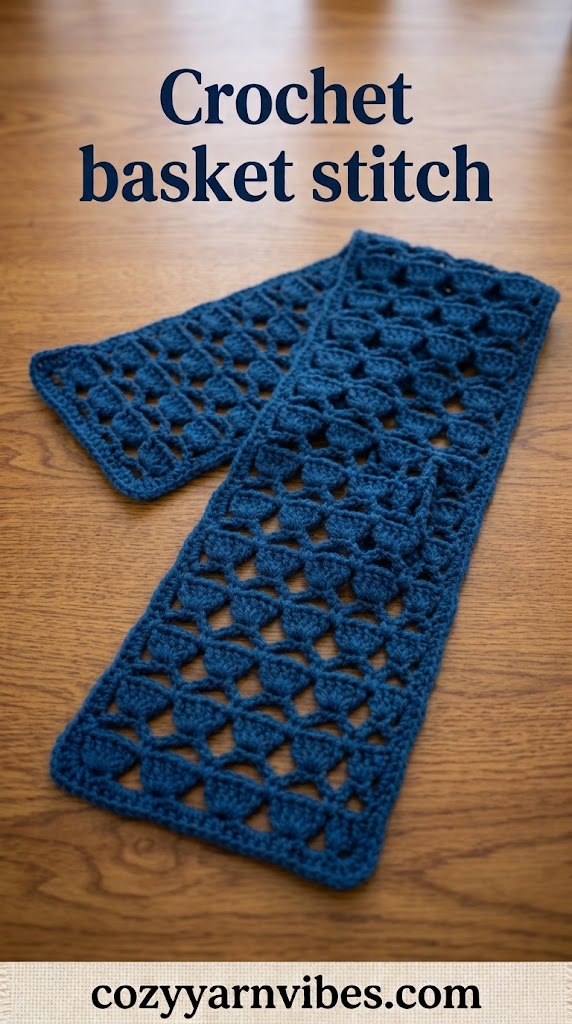
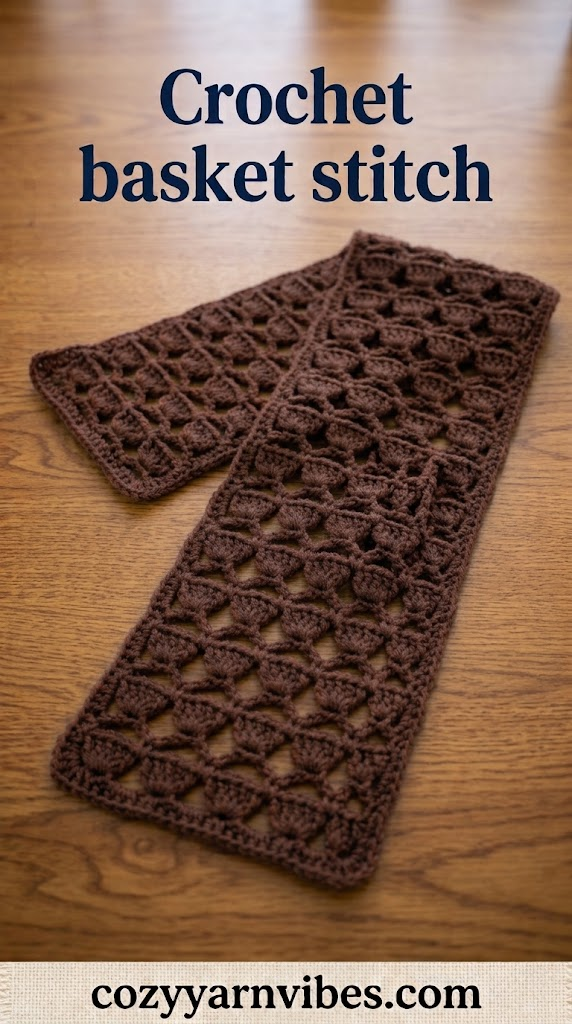
The basket stitch can add visual interest to scarves, wraps, and shawls. Choose a yarn with good stitch definition so the 5-dc shells and chain spaces remain easy to see.
Garments
Use the stitch for sweaters, cardigans, vests, ponchos, and other garments. It can be used throughout a piece or combined with simpler stitches for contrast.
Home Décor
The structured appearance of the basket stitch makes it suitable for cushion covers, pillow covers, table runners, placemats, and decorative panels.
Accessories
Try the basket stitch for bags, purses, cowls, scarves, hats, and other accessories. The repeating texture can give simple accessories a distinctive handmade appearance.
Variations of the Basket Stitch
The basic basket stitch can be adapted in several ways to create different looks while keeping the same fundamental structure.
- Use two or more colors to emphasize the alternating shell rows and chain-space rows.
- Try different yarn weights to change the size and definition of the shells.
- Combine basket stitch sections with rows of single crochet or double crochet.
- Use the stitch as a textured panel within a larger project.
- Experiment with different fibers to create softer or more structured fabrics.
Changing the yarn, colors, or surrounding stitches can give the basket stitch a completely different appearance while preserving its characteristic shell pattern.
More Crochet Stitch Tutorials
Continue building your crochet skills with these beginner-friendly stitch guides:
- Single Crochet Stitch (sc)
- Half Double Crochet Stitch (hdc)
- Double Crochet Stitch (dc)
- Treble Crochet Stitch (tr)
- Bead stitch
Learning different crochet stitches makes it easier to combine textures and create your own crochet designs. Once you are comfortable with the basket stitch, try combining it with basic stitches to create textured sections and decorative panels.
Conclusion
The basket stitch is a textured crochet pattern that creates a distinctive woven appearance using simple 5-dc shells, single crochet stitches, and chain-5 spaces.
The first row establishes the shell groups, while Row 2 creates the open spaces between them. Row 3 then works new 5-dc shells into those spaces. After the setup rows are complete, repeating Rows 2 and 3 allows you to continue the pattern to any desired length.
With consistent tension and careful stitch placement, the basket stitch can be used for blankets, scarves, shawls, garments, accessories, and home décor projects. Practice the three setup rows on a small swatch first, then repeat Rows 2 and 3 to build your project.
Frequently Asked Questions (FAQs)
1. Is the basket stitch suitable for beginners?
Yes. The basket stitch is suitable for beginners who are comfortable with basic crochet stitches such as single crochet and double crochet. The main technique to learn is working 5-dc shells into the correct chains and chain spaces.
2. What is the foundation chain multiple for the basket stitch?
The foundation chain follows the formula (any multiple of 5) + 2, plus 3. The additional 3 chains are used for the beginning turning chain in Row 1.
3. How many double crochets are in each shell?
Each shell consists of 5 double crochet stitches. These groups of five double crochets are the main textured element of the basket stitch.
4. What is the purpose of the chain-5 spaces?
The chain-5 spaces created in Row 2 provide the spaces where the 5-dc shells are worked in Row 3. They also create the open areas between the raised shell groups.
5. How do I repeat the basket stitch?
After completing Rows 1 through 3, repeat Rows 2 and 3 until you reach the desired length. Row 2 creates the chain-5 spaces, and Row 3 works 5-dc shells into those spaces.
6. Why does my basket stitch look uneven?
Uneven basket stitch can be caused by inconsistent tension, uneven chain spaces, or incorrect shell placement. Make sure your chain-5 spaces are similar in size and that each 5-dc shell in Row 3 is worked into the third chain of the correct chain-5 space.
7. What can I make with the basket stitch?
The basket stitch can be used for blankets, scarves, shawls, garments, bags, cowls, cushion covers, table runners, placemats, and other crochet projects where you want a structured textured pattern.