
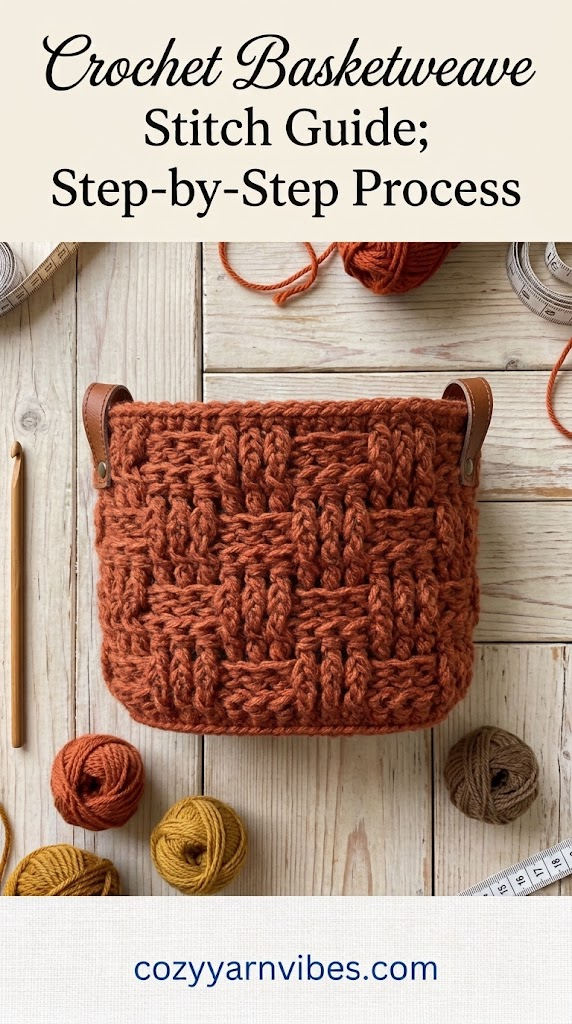
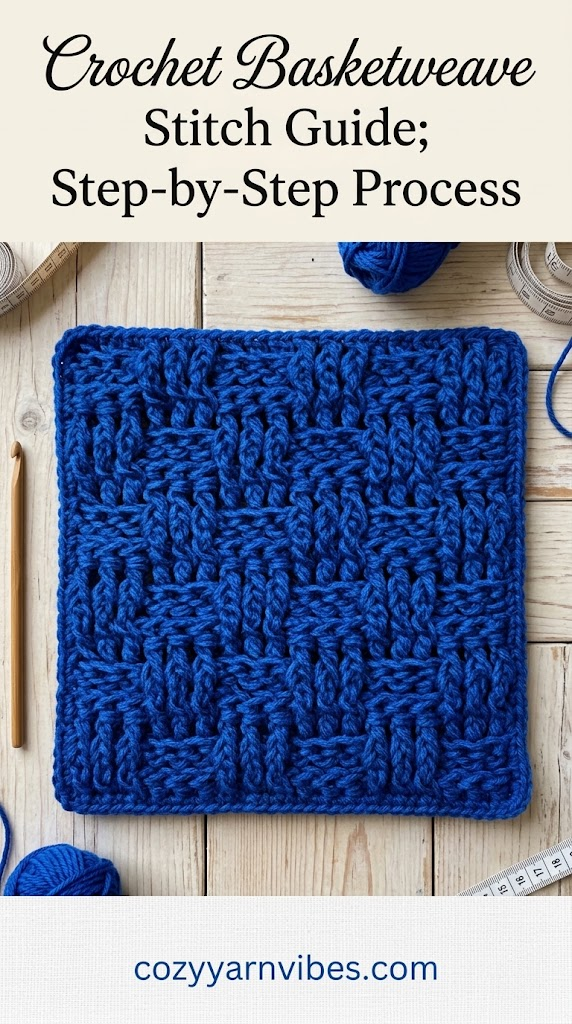
The Basketweave Stitch is a textured crochet stitch that creates a woven appearance by alternating front post and back post double crochet stitches. The raised and recessed sections resemble the look of woven basket fibers, giving the finished fabric a thick and dimensional texture.
This stitch is especially useful for projects where you want warmth, structure, and visual texture. It works beautifully for blankets, scarves, cushions, bags, baskets, and other home décor projects. Although the stitch looks intricate, it is created with basic double crochet stitches and post stitches once you understand where to place your hook.
Basketweave Stitch Definition
The Basketweave Stitch is a crochet technique made by alternating groups of front post double crochet and back post double crochet stitches. Working around the posts of stitches from the previous row creates raised sections that stand out from the fabric.
The direction of these groups changes every two rows. One pair of rows uses front post double crochet followed by back post double crochet, while the next pair reverses the order. This creates the characteristic woven or basket-like pattern.
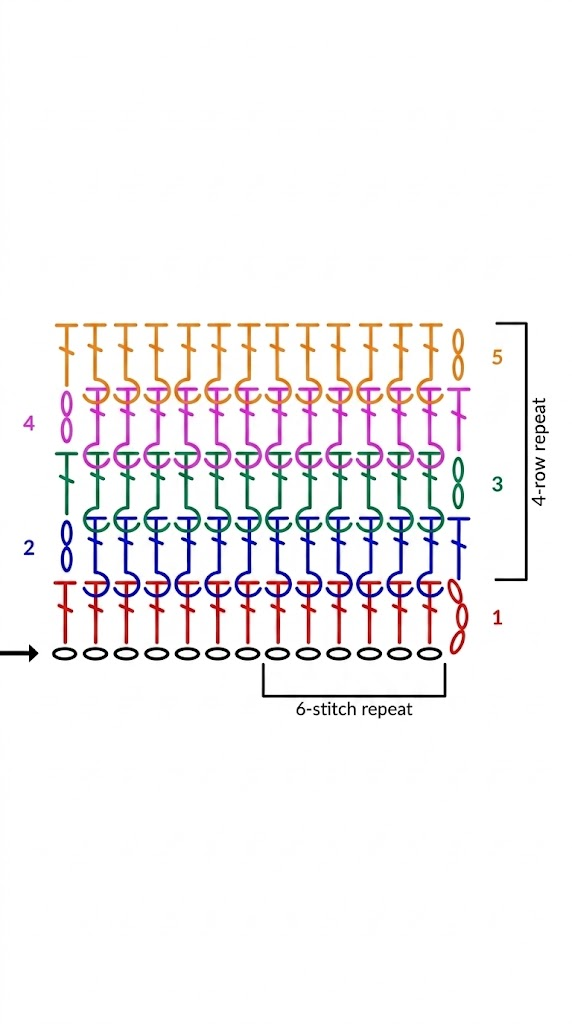
The stitch is usually worked over a multiple of 6 stitches, making it easy to adjust the width of your project. The texture becomes more noticeable with each completed set of rows.
Abbreviations
This free pattern is written using US crochet terms.
| beg | beginning |
| ch | chain |
| bpdc | back post double crochet |
| dc | double crochet |
| fpdc | front post double crochet |
| rep | repeat |
| st (s) | stitch (es) |
| t-ch | turning chain |
How to Crochet the Basketweave Stitch
Foundation Chain
The Basketweave Stitch is worked over a multiple of 6 stitches, plus 1 chain, followed by 3 beginning chains.
Foundation chain: (Multiple of 6 ch) + 1 ch, plus 3 beg ch.
For a small sample swatch, you can make:
(6 × 3) + 1 + 3 = 22 chains
This gives you enough stitches to practice three complete 6-stitch repeats.
Row 1: Create the Base
Row 1 creates a simple double crochet foundation that will be used for the post stitches in the following rows.
- Chain 22 for the sample swatch.
- Work 1 double crochet in the 4th chain from the hook.
- Work 1 double crochet in each remaining chain across.
- Turn your work.
You now have a solid row of double crochet stitches that forms the foundation for the Basketweave texture.
Row 2: Begin the Basketweave Texture
Row 2 begins the first set of raised and recessed sections.
- Chain 2. This counts as the first double crochet.
- Work 1 front post double crochet in each of the next 3 stitches.
- Work 1 back post double crochet in each of the next 3 stitches.
- Repeat the sequence of 3 fpdc, 3 bpdc across the row.
- Work 1 double crochet in the top of the turning chain.
- Turn your work.
The front post double crochet stitches create raised sections on the front of the fabric, while the back post double crochet stitches sit farther back.
Row 3: Repeat Row 2
Row 3 continues the same stitch arrangement so that the first set of vertical textured blocks becomes more defined.
- Repeat Row 2.
- Work 3 fpdc followed by 3 bpdc across the row.
- Finish with 1 double crochet in the top of the turning chain.
- Turn your work.
Keeping the same post stitch placement for two rows helps create the first set of basketweave blocks.
Row 4: Reverse the Stitch Pattern
The direction of the post stitches changes in Row 4. This reversal is what creates the woven appearance.
- Chain 2. This counts as the first double crochet.
- Work 1 back post double crochet in each of the next 3 stitches.
- Work 1 front post double crochet in each of the next 3 stitches.
- Repeat the sequence of 3 bpdc, 3 fpdc across the row.
- Work 1 double crochet in the top of the turning chain.
- Turn your work.
You should notice that the raised sections now appear over the recessed sections from the previous rows.
Row 5: Repeat Row 4
Row 5 continues the reversed stitch arrangement.
- Repeat Row 4.
- Work 3 bpdc followed by 3 fpdc across the row.
- Finish with 1 double crochet in the top of the turning chain.
- Turn your work.
After completing Row 5, the first basketweave section is clearly visible.
Continue the Basketweave Pattern
Keep working the rows in pairs to build the full Basketweave texture:
- Rows 2–3: 3 fpdc, 3 bpdc
- Rows 4–5: 3 bpdc, 3 fpdc
- Rows 6–7: 3 fpdc, 3 bpdc
- Rows 8–9: 3 bpdc, 3 fpdc
Keep alternating these two-row sections until your project reaches the desired length.
The repeated changes in direction create blocks that look like woven strips crossing over one another.
Understanding Front Post and Back Post Double Crochet
The Basketweave Stitch becomes much easier once you understand where the hook goes for post stitches.
Front Post Double Crochet (fpdc)
For a front post double crochet, insert your hook around the post of the stitch from the front of your work. Yarn over, pull up a loop, and complete the double crochet as usual.
This pulls the stitch toward the front and creates a raised section.
Back Post Double Crochet (bpdc)
For a back post double crochet, insert your hook around the post of the stitch from the back of your work. Yarn over, pull up a loop, and complete the double crochet.
This pushes the stitch toward the back and creates a recessed section.
Alternating these two stitches is what gives the Basketweave Stitch its dimensional texture.
Tips for Perfect Basketweave Stitch
- Keep your tension consistent throughout the project.
- Count your stitches at the end of each row.
- Make sure your foundation chain is based on a multiple of 6, plus 1 chain and 3 beginning chains.
- Work the post stitches around the posts rather than into the tops of the stitches.
- Remember which direction you are working for each pair of rows.
- Keep the three front post and three back post stitches grouped together.
- Do not pull the post stitches too tightly.
- Make sure the turning chain is worked correctly at the end of each row.
- Use a smooth yarn when learning so you can clearly see the stitch posts.
- Make a small swatch before starting a larger project.
The Basketweave Stitch naturally creates a dense fabric, so avoid making your tension too tight. A slightly relaxed tension can make the stitch easier to work and help the finished fabric remain flexible.
Common Mistakes to Avoid
The Basketweave Stitch involves working around stitch posts, so it can be easy to lose track of the stitch pattern while learning.
Here are some common mistakes to watch for:
- Starting with the wrong number of chains.
- Forgetting that the chain 2 counts as a double crochet.
- Working into the top of a stitch instead of around its post.
- Accidentally switching fpdc and bpdc positions.
- Forgetting to reverse the stitch sequence after two rows.
- Working too tightly around the stitch posts.
- Missing the final double crochet in the top of the turning chain.
- Adding or skipping stitches at the edges.
- Losing track of where each three-stitch group begins.
- Failing to count the stitches after completing a row.
If the basketweave blocks do not line up, check the previous two rows before continuing. A misplaced post stitch can affect the appearance of several rows.
Projects You Can Make with the Basketweave Stitch
The Basketweave Stitch creates a thick and structured fabric, making it suitable for many practical and decorative crochet projects.
Blankets and Afghans
Basketweave blankets are popular because the textured fabric is warm and substantial. You can make a simple one-color blanket or alternate colors between sections to emphasize the woven design.
Scarves
The dense texture makes the Basketweave Stitch a good choice for warm scarves. Choose a soft yarn and a slightly larger hook if you want a fabric with more drape.
Cushions
Use the stitch to create textured cushion covers. The raised blocks can add visual interest to an otherwise simple home décor project.
Bags
The structured fabric works well for crochet bags, totes, and pouches. The basket-like texture can also complement the shape of a woven-style bag.
Baskets
The Basketweave Stitch is particularly appropriate for decorative crochet baskets. Use a sturdy yarn and suitable hook size to create a firmer fabric.
Home Décor
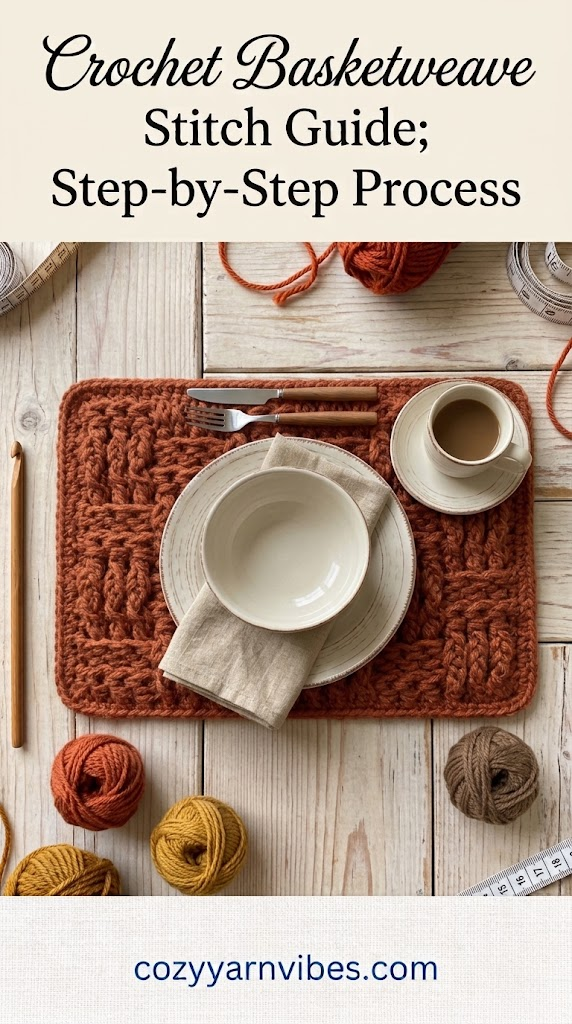
Try the stitch for throws, table runners, placemats, and other textured home accessories. Its geometric texture works well with both modern and traditional designs.
Baby Projects
The stitch can also be used for baby blankets and other accessories. Choose a soft, washable yarn and avoid making the fabric excessively dense.
Variations of the Basketweave Stitch
The basic Basketweave Stitch can be adapted in several ways to create different textures and designs.
Different Color Combinations
You can work the entire stitch in one color for a subtle textured effect or change colors between sections to make the woven blocks more visible.
Using two contrasting colors can emphasize the alternating sections, while several coordinated colors can create a more colorful design.
Larger Basketweave Blocks
The traditional pattern uses groups of three front post and three back post double crochet stitches. You can experiment with different group sizes to create wider or narrower woven sections.
Keep the stitch repeat consistent throughout the project so the texture remains aligned.
Different Yarn Weights
The Basketweave Stitch can be made with different yarn weights. Thicker yarn produces large, prominent textured blocks, while thinner yarn creates a smaller and more delicate pattern.
Always check your tension with a swatch before beginning a large project.
Changing the Project Width
Because the stitch is based on a multiple of 6, you can easily adjust the width of your project.
Start with a foundation chain based on:
(multiple of 6) + 1 + 3 beginning chains
For example:
- 19 + 3 = 22 chains
- 25 + 3 = 28 chains
- 31 + 3 = 34 chains
The additional 3 chains are the beginning chain required by the pattern.
More Crochet Stitch Tutorials
Continue building your crochet skills with these beginner-friendly stitch guides:
- Single Crochet Stitch (sc)
- Half Double Crochet Stitch (hdc)
- Double Crochet Stitch (dc)
- Treble Crochet Stitch (tr)
- Shell Stitch
The Basketweave Stitch is a useful addition to your crochet skills because it teaches you how to work around stitch posts while creating a highly textured fabric.
Conclusion
The Basketweave Stitch is a beautiful textured crochet stitch that combines groups of front post and back post double crochet stitches to create a woven appearance. Its structured texture makes it especially useful for blankets, scarves, bags, baskets, cushions, and home décor.
The key to mastering this stitch is understanding the difference between front post and back post double crochet and remembering when to reverse the stitch sequence. Once you become comfortable with the pattern, the repeating rows are straightforward to work.
Start with a small swatch and practice the two-row sections. Once the basketweave pattern becomes familiar, you can adjust the width, yarn, colors, and project type to create your own textured crochet designs.
Frequently Asked Questions (FAQs)
Is the Basketweave Stitch suitable for beginners?
Yes. The Basketweave Stitch is suitable for adventurous beginners who are comfortable with double crochet. The main technique to learn is working front post and back post double crochet around the stitch posts.
What yarn is best for the Basketweave Stitch?
A smooth yarn with good stitch definition is a good choice when learning the Basketweave Stitch. Medium-weight yarn is particularly useful for practice because the stitch posts are easy to see.
What crochet hook should I use?
Use the crochet hook recommended for your chosen yarn. Since the Basketweave Stitch creates a dense fabric, you can experiment with a slightly larger hook if you want a softer and more flexible result.
How many chains do I need for the Basketweave Stitch?
The foundation chain should be a multiple of 6, plus 1 chain and 3 beginning chains. For example, a sample using three repeats requires 22 chains.
Why does my Basketweave Stitch look uneven?
Uneven tension or incorrectly placed post stitches can affect the appearance of the Basketweave Stitch. Check that you are consistently working around the correct stitch posts and that your groups contain three fpdc or three bpdc as required.
Does the Basketweave Stitch use a lot of yarn?
Yes. The raised post stitches create a dense, textured fabric, so the stitch generally uses more yarn than a simple double crochet fabric. Keep this in mind when estimating yarn requirements for a larger project.
Can I use the Basketweave Stitch for a blanket?
Yes. The Basketweave Stitch is particularly well suited to blankets and afghans because it creates a warm, thick texture. You can use one color or change colors between sections to highlight the woven design.
Can I make the Basketweave Stitch with different yarn weights?
Yes. You can use different yarn weights, but the finished texture and size will change. Always make a small swatch to check the fabric before starting your project.